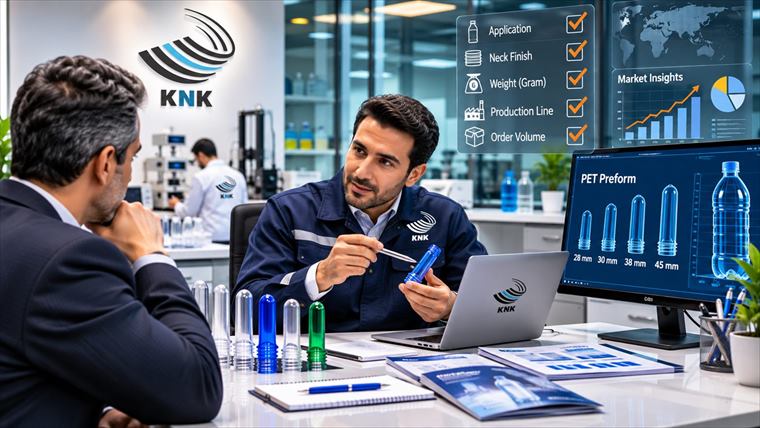
What Should You Test Before Buying PET Preforms in Bulk? A Guide to Sample Evaluation on the Production Line
2026/11/09
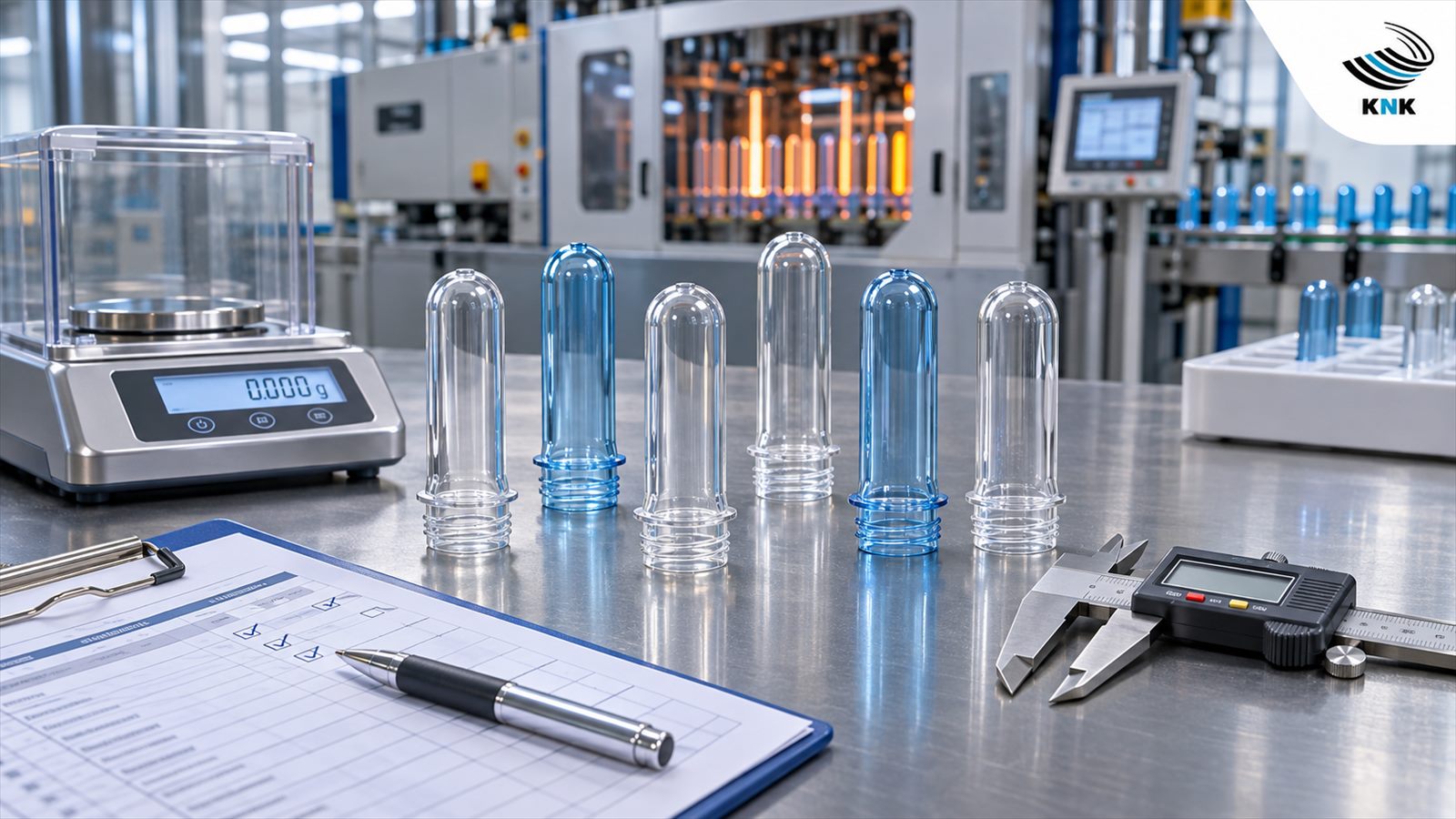
Correct weight and good appearance alone are not enough to approve a PET preform. The sample should match the agreed specifications and, when necessary, be evaluated under actual production conditions. This guide explains what to inspect before placing a bulk PET preform order and why production-line testing can reduce purchasing risk.
Imagine receiving a PET preform sample that looks clear, has the requested weight, and appears to have the correct neck dimensions. Is that enough to confidently place a large-volume order?
Not necessarily.
In industrial manufacturing, PET preform quality becomes meaningful when the product not only matches the agreed specifications but also performs consistently under the customer's actual production conditions.
A sample may look acceptable during visual inspection but behave differently during heating, Stretch Blow Moulding, bottle formation, or interaction with the closure and mould.
For this reason, especially in new projects or when changing suppliers, PET preform sample testing can be an important part of the purchasing decision.
Why Should a PET Preform Sample Be Evaluated Before a Bulk Order?
An industrial order is not simply about purchasing individual preforms. Those preforms may eventually enter a production line manufacturing thousands or millions of bottles.
Under these conditions, even a relatively small mismatch can contribute to increased scrap, additional machine adjustments, inconsistent bottle quality, or unstable production.
The purpose of sample evaluation is therefore not simply to decide whether a supplier should be “accepted” or “rejected.”
The more important question is:
Does the PET preform match the required specification and work properly with the bottle design, closure, mould, and actual production line?
Acceptance criteria should therefore be based as much as possible on the agreed Drawing, Specification, Neck Finish standard, and customer requirements.
Using one universal dimensional tolerance for all PET preforms is not an accurate technical approach because designs and applications differ.
Step One: Compare the Sample with the Agreed Specifications
The first stage is relatively straightforward: make sure the sample you received is actually the product you requested.
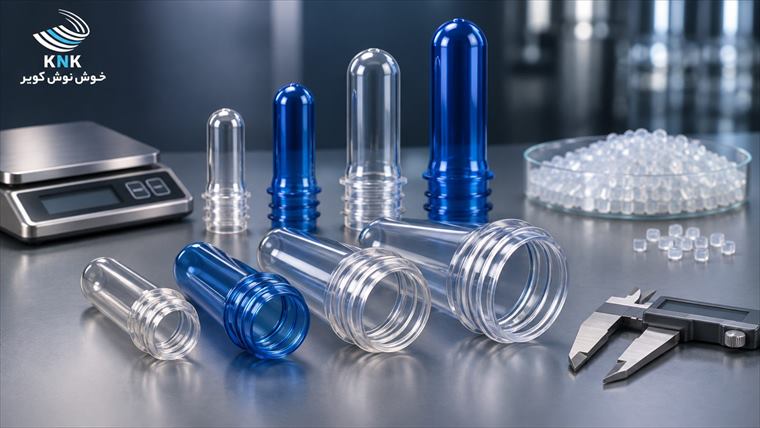
Depending on the agreed technical specification, important characteristics may include preform weight, overall geometry and length, colour, Neck Finish, thread condition, sealing surface, Support Ring, and Gate condition.
Wall thickness and uniformity, clarity, colour consistency, contamination, and visible defects may also be relevant depending on the product and quality-control plan.
Each characteristic should be compared with the applicable Drawing and Specification rather than with a general number assumed to apply to every PET preform.
The Neck Finish deserves particular attention because, unlike the preform body that is stretched and reshaped during blow moulding, the neck area largely retains the geometry created during injection moulding.
Is a Clear PET Preform Automatically a High-Quality Preform?
No.
Good transparency can be an important characteristic for many PET applications, but a clear-looking preform does not automatically satisfy every technical requirement.
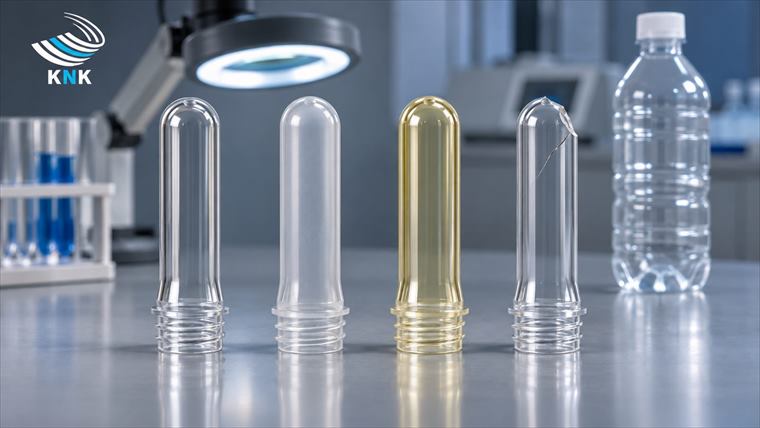
The sample may also need to be inspected for abnormal colour variation, Haze, foreign particles, Black Specks, bubbles, surface damage, and Gate-related defects.
As discussed in KNK's article on cloudy, yellow, or brittle PET preforms and bottles, visible defects can sometimes indicate issues related to material condition or processing.
However, the absence of visible defects does not by itself guarantee good performance on a blow moulding machine.
For this reason:
Visual Inspection is an important step, but it should not always be the final step in sample approval.
For industrial applications, it is also important to understand how the product behaves during actual processing.
Check the Neck Finish and Closure Before Placing a Bulk Order
One potentially costly mistake is leaving the compatibility between the preform neck and the closure until the final stages of a project.
A PET preform Neck Finish includes several geometrical features related to the thread, sealing area, and Support Ring. These features should be compatible with the selected closure and the line's capping system.
This means that specifications such as “28 mm preform” or “30 mm preform” alone may not provide enough information for an industrial purchasing decision.
For example, within the Khosh Noosh Kavir product range, a 28 mm PCO 1810 preform and a 30 mm Short Neck 29/25 preform are based on different Neck Finish systems and serve different packaging requirements.
The same principle applies to the 38 mm and 45 mm product families.
Whenever a new closure or Neck Finish standard is introduced, compatibility between the preform, closure, and capping system should be considered before a large-volume order is confirmed.
The Most Important Stage: Testing the Preform on the Blow Moulding Machine
For many projects, the most valuable stage of sample evaluation begins when the PET preform enters the customer's actual PET Stretch Blow Moulder.
Why?
Because a technically acceptable preform should not only meet dimensional requirements. It should also be capable of forming the intended bottle under an appropriate heating, stretching, and blowing process.
During this stage, manufacturers may evaluate how the preform responds to heating, how the bottle forms, how material is distributed through the shoulder, body, and base, and whether the final bottle geometry is produced consistently.
Depending on the application and available quality-control equipment, bottle inspection may also include factors such as Material Distribution, Wall Thickness Distribution, Pearlescence, Turbidity, Gate Position, and other bottle defects.
However, universal temperatures, pressures, or Heat Profiles should not be applied to every production line.
The appropriate processing window depends on several factors, including:
- preform geometry;
- preform weight;
- bottle design;
- mould design;
- blow moulding equipment;
- production speed;
- and process conditions.
The goal of a sample test is therefore not to judge a preform using a generic setting taken from another machine or application.
The goal is to determine:
How does this preform perform on the customer's actual production line within a suitable Process Window?
Is One Good Bottle Enough to Approve a PET Preform Sample?
Not always.
This is one of the most important points in PET preform evaluation.
If one acceptable bottle can be produced after several adjustments, that does not automatically prove that the preform will support stable industrial production.
A more important question is:
Can the result be repeated consistently?
Industrial production depends on repeatability.
The preform should remain within the agreed product specifications, while the blow moulding process should be capable of repeatedly producing acceptable bottles under controlled production conditions.
For this reason, sample approval should not necessarily be based only on the “best bottle” produced during a test.
The repeatability and stability of the process also matter.
This reflects one of the most important principles of industrial quality:
Real quality is quality that can be repeated.
When Does PET Preform Sample Testing Become Especially Important?
The appropriate approval procedure depends on each customer's project and quality requirements, but sample testing becomes particularly valuable when important production variables change.
Typical situations include:
- introducing a new bottle design;
- changing the mould;
- reducing or increasing preform weight;
- changing the Neck Finish;
- changing the closure;
- working with a new supplier;
- or implementing a Lightweighting project.
If the existing preform performs reliably on the production line and a new product is being considered as a replacement, comparing the new sample with an approved reference sample can also provide useful technical information.
In many cases, this comparison is more meaningful than evaluating the new sample in isolation.
How Should Test Results Be Reported to the Sales Consultant?
Technical communication between the customer and supplier becomes much more effective when test results are described precisely.
Instead of reporting only that “the sample was not good,” it is more useful to explain where the problem occurred.
For example:
Was the Neck Finish incompatible with the closure?
Did the preform require significant Heat Profile adjustments?
Was Pearlescence or whitening observed?
Did the bottle base fail to form correctly?
Was Material Distribution unsatisfactory?
Or did the sample run successfully without any significant production problem?
Information about the bottle design, preform weight, Neck Finish, mould, and general blow moulding conditions can help the sales and technical teams understand the issue more accurately.
This is also why pre-purchase consultation is valuable: the best purchasing decisions are made when information from the actual production line becomes part of the selection process.
Bulk PET Preform Purchasing: Approve the Sample Before Focusing on Final Price
Price is an important part of every bulk purchasing decision.
However, a PET preform that is not technically compatible with the production line can create additional costs even when its initial purchasing price appears attractive.
Before finalising a significant order, it is therefore useful to confirm that the selected preform is suitable in terms of:
- Neck Finish;
- weight;
- visual condition;
- closure compatibility;
- and performance on the production line.
Khosh Noosh Kavir manufactures different PET preform families for applications including mineral water, carbonated beverages, doogh, milk, juice, and other PET packaging requirements.
Customers evaluating a new product, changing preform weight, or considering another preform family can provide their bottle and production-line specifications to the KNK sales team to support a more accurate sample-selection process.
Before deciding how many preforms to order, first make sure you have selected a preform that your production line can consistently convert into the required bottle.
Frequently Asked Questions About PET Preform Testing
Should PET Preform Samples Be Tested Before a Bulk Purchase?
Sample testing can be particularly valuable when starting a new project, changing suppliers, modifying preform weight, introducing a new mould, or changing the bottle design. The scope of testing should be determined according to the project's specification and production requirements.
How Can I Know Whether a Preform Is Compatible with My Blow Moulding Machine?
Initial dimensional compatibility alone may not be sufficient. A more useful evaluation is performed by processing the sample under controlled conditions on the actual production line, or under conditions close to real production, and assessing bottle formation and process stability.
Are Weight and Transparency Enough to Approve PET Preform Quality?
No. Neck Finish, Gate condition, colour, contamination, dimensional compliance, and performance during Stretch Blow Moulding may also be important.
If One Good Bottle Is Produced, Can We Proceed with a Bulk Order?
Producing one acceptable bottle is a positive sign, but industrial production also requires repeatability. Process stability and the ability to consistently produce acceptable bottles should also be considered.
Conclusion: Do Not Just Look at the Sample — Evaluate Its Real Production Performance
PET preform approval should not be based only on clear appearance, correct weight, or an attractive price.
The sample should first be compared with the agreed Drawing and Specification. Its Neck Finish and visual condition should then be inspected, and for projects where production compatibility is particularly important, its performance during blow moulding and the resulting bottle should also be evaluated.
A suitable PET preform should successfully pass three basic stages:
It should match the agreed specifications, meet the relevant quality-control requirements, and behave predictably on the customer's actual production line.
To evaluate a preform for your production line, you can provide Khosh Noosh Kavir with information about your bottle, Neck Finish, target preform weight, closure, mould, and general blow moulding conditions so that the most appropriate product can be considered.
In bulk PET preform purchasing, an approved sample is not simply a piece of plastic; it represents a product that may be expected to repeat the same level of quality thousands or millions of times.